

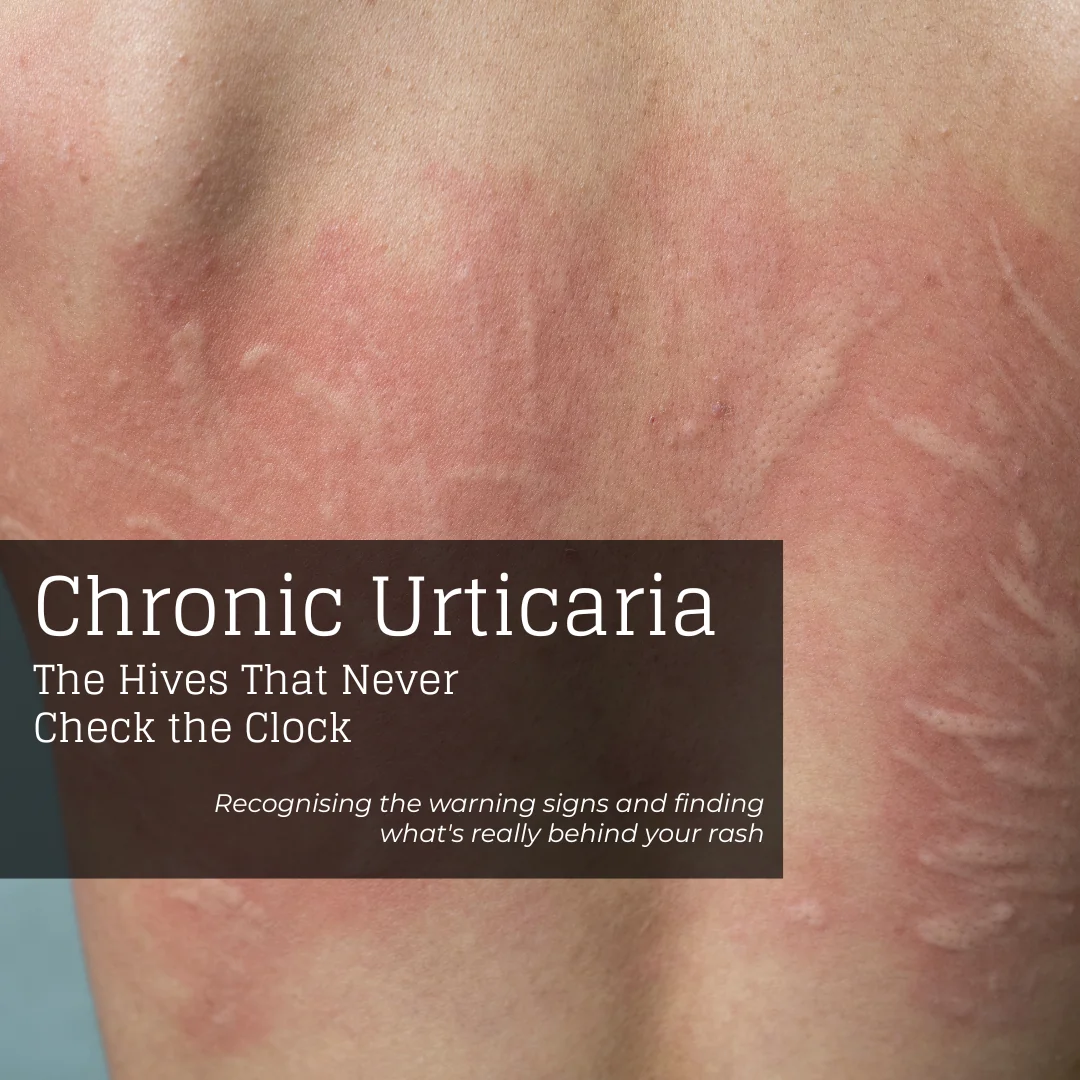
Opening: Why Chronic Urticaria Deserves More Attention
In my clinic, there's a group of patients I worry about in a particular way — not because their condition is immediately life-threatening, but because they're exhausted. Exhausted from not knowing whether today will bring another flare. Exhausted from carrying antihistamines everywhere they go. And exhausted from a question that never seems to get a clear answer: "Doctor, what's actually causing this?"
Those patients are living with chronic urticaria.
Urticaria — commonly known as hives — affects roughly 15–25% of the global population at some point in their lives. But what concerns me more is the subset who keep coming back: flaring more than three times a week, for longer than six weeks straight. That's what we define as chronic urticaria, and its impact on quality of life is far greater than most people expect.
- 2 : 1 Twice as common in women as in men
- 20–40 Peak onset age (years)
- 40% Symptoms lasting over 1 year
- DLQI Quality of life comparable to chronic heart disease
Hives recurring for more than 6 weeks? Message Dr. Bank on Line for a consultation.
Message on LineWhat Is Urticaria? Understanding the Basics
I often explain to patients that urticaria isn't just a rash. It's a signal that your immune system is overreacting. When a trigger is encountered, mast cells and basophils beneath the skin release histamine — causing raised, red, intensely itchy welts.

2.1 What the Rash Actually Looks Like
- Raised red or pink welts with clearly defined edges, from small spots to larger than a palm
- Intense itching — often worst at night, sometimes severe enough to disrupt sleep
- Each welt typically resolves within 24 hours, but new ones appear elsewhere
- No crusting or weeping — helps distinguish from contact dermatitis or fungal infections
2.2 The Swelling You Shouldn't Ignore: Angioedema
Some patients also develop deeper swelling called angioedema — typically affecting the lips, eyelids, hands, feet, or genitalia. Please don't ignore this. If swelling occurs in the throat or airway, it can become life-threatening very quickly.
Acute vs. Chronic: Knowing the Difference
How we classify urticaria by duration matters — it determines the entire treatment approach.
Acute · < 6 weeks: Usually an identifiable trigger — medication, food, or viral infection. Generally straightforward to manage once the trigger is avoided.
Chronic · > 6 weeks: Hives more than 3 times per week for longer than 6 weeks — dedicated medical management becomes essential.
CSU — Spontaneous (80–90%)
- Hives appear and disappear without a clear trigger
- Believed to involve an autoimmune mechanism
- Usually requires prolonged treatment
CIndU — Inducible triggers
- Dermographism: stroking skin causes raised welts
- Cold urticaria: contact with cold triggers hives
- Cholinergic: sweating, heat, or exercise
Chronic urticaria needs medical care — book a free consultation via Line.
Book via LineWhat Causes Chronic Urticaria? Tracking Down the Culprit
In most patients with chronic urticaria, we cannot identify a definitive cause — that's why the term "idiopathic" is used. But here are the mechanisms and contributing factors we do know about.

- Autoimmune (35–40%) — Autoantibodies directly activate mast cells — the body triggers itself
- Chronic infections — H. pylori, dental/periodontal disease, Candida, hepatitis viruses, parasites
- Thyroid disease (10–15%) — Often Hashimoto's thyroiditis — some patients don't know they have it
- Stress — Stress response stimulates mast cells via neuropeptides
4.5 Food and Additives
True IgE-mediated food allergy causes chronic urticaria in fewer than 5% of patients. However, certain components can activate mast cells through non-IgE pathways — including salicylates, food colourings (e.g. Tartrazine), preservatives, and alcohol.
Important caveat: Broad allergy panels (IgE testing) often produce false positives in chronic urticaria. Let your physician guide which tests are actually indicated — don't order everything at once. Avoid eliminating nutritious foods without solid medical justification.
Warning Signs That Need Immediate Medical Attention

There are certain symptoms where waiting is not an option — and where taking an antihistamine and lying down is the wrong response.
Emergency — go to the ER immediately if you have:
- Rapid swelling of the throat, tongue, or lips
- Difficulty breathing, wheezing, or sudden hoarseness
- Low blood pressure, dizziness, or loss of consciousness
- Rapid or irregular heartbeat
- Multiple symptoms at once = anaphylaxis → go to the ER immediately
Anaphylaxis requires epinephrine (adrenaline) — not a standard antihistamine. If you have a history of severe allergic reactions, I strongly recommend carrying an EpiPen.
Not an emergency, but want a professional assessment? Message us on Line.
Message on LineHow Is It Diagnosed? The Workup Explained
When a patient comes to me with urticaria lasting more than six weeks, I always start by listening carefully. A thorough history often tells me more than any blood test could.

6.1 History taking — the most important step
- When do hives appear? What time of day, and how long does each episode last?
- Clear triggers: foods, medications, stress, cold, or exercise
- Current medications — particularly NSAIDs and ACE inhibitors
- Underlying conditions and family history of allergy or autoimmune disease
6.2 Blood tests
- CBC, ESR, CRP — inflammation markers
- TSH, Free T4, Anti-TPO — thyroid function (every case)
- Total IgE, H. pylori testing
- ANA, Anti-dsDNA if autoimmune disease is suspected
6.3 Skin tests
- Skin Prick Test (SPT) when allergens are suspected
- ASST — tests for autoimmune activation (positive in 40–60% of CSU)
- Dermographometry — standardized skin stroking test
Wondering which tests you need? Ask Dr. Bank on Line.
Ask about testingTreatment: A Step-by-Step Approach
My approach follows the EAACI/GA²LEN 2022 guidelines — starting with the simplest, safest options and stepping up based on how the patient responds.

1 — Second-generation H1 antihistamines
Cetirizine, loratadine, fexofenadine, bilastine, desloratadine — safe, once-daily, and the dose can be increased up to fourfold when standard dosing isn't sufficient.
- Cetirizine 10 mg — widely used
- Loratadine 10 mg — least sedating
- Fexofenadine 120/180 mg — virtually non-sedating
- Bilastine 20 mg — rapid onset, low sedation
- Desloratadine 5 mg — stronger antihistamine effect
2 — Updosing antihistamines
If standard dosing over 2–4 weeks hasn't brought relief → increase to 2–4 times the standard dose, e.g. cetirizine 20–40 mg daily.
3 — Montelukast — adjunctive option
A leukotriene receptor antagonist that can complement antihistamine therapy — particularly when NSAIDs worsen hives.
4 — Omalizumab (Xolair) — biologic therapy
Monoclonal antibody targeting IgE, injected every 4 weeks. 60–70% of patients achieve meaningful improvement in clinical trials.
5 — Cyclosporin — severe refractory cases
Immunosuppressant effective in autoimmune-driven urticaria. Requires close monitoring of blood pressure and kidney function.
Common questions about Omalizumab
- "Do I have to inject it for life?" — Not necessarily. I reassess every 3–6 months.
- "Is it expensive?" — It is, but generics are available and it may be covered under Thailand's gold card scheme.
- "Is it safe?" — Excellent safety profile with over 10 years of post-approval data.
- "How quickly does it work?" — Some patients improve after the first injection; others take around 3 months.
Want a treatment plan tailored to you? Message Dr. Bank on Line.
Discuss treatmentManaging Urticaria at Home
Medication is essential — but lifestyle adjustments make a real difference too. Here's what I advise every patient.
What to do
- Keep a urticaria diary — note when hives appear and possible triggers
- Wear loose, breathable cotton clothing
- Bathe in lukewarm water — not hot
- Apply a cold compress instead of scratching
- Keep nails trimmed short
What to avoid
- NSAIDs such as ibuprofen and aspirin (unless medically necessary)
- Alcohol in any form
- High-histamine foods: aged cheeses, fermented foods, very fresh tuna
- Intense heat or direct sun exposure
- Accumulated stress — consistent sleep and stress management help
Questions I'm Asked Most Often
Can chronic urticaria be cured?
Yes — though it takes time. Studies show 50% of CSU patients achieve remission within one year, and 80% within five years. Medication helps control symptoms in the meantime; some achieve full remission with omalizumab.
Do I need to avoid all seafood?
Not necessarily. Seafood is not a primary cause in most patients unless a genuine allergy is confirmed. I don't recommend eliminating nutritious foods without solid medical justification.
Will I become dependent on antihistamines if I take them long-term?
Second-generation antihistamines don't cause dependency. However, stopping abruptly in severe cases can cause a flare. I typically taper the dose gradually rather than stopping all at once.
Can stress-induced urticaria be treated?
Yes — but it needs a combined approach: medication plus stress management. I often recommend mindfulness practices or referral to a clinical psychologist alongside medical treatment.
How is urticaria different from eczema?
Individual urticaria welts resolve within 24 hours without crusting or weeping. Eczema persists much longer, involves dry scaly skin, and typically favours skin folds.
Still have questions? Ask Dr. Bank on Line anytime.
Ask on LineClosing Thoughts from Dr. Bank
Chronic urticaria can be a long companion — and its impact on daily life is more significant than it might appear from the outside. But we have far better tools to manage it today than we did even a decade ago.
Don't manage this alone for too long. Chronic urticaria looks different in every patient, and the most effective treatment plan is one tailored to you through a thorough evaluation by a dermatologist.
Consult Dr. Bank at 22 Square Clinic
If you or someone close to you has been experiencing recurrent hives for more than six weeks
Book a consultation on LineMedical references (10 sources)
- Zuberbier T, et al. The EAACI/GA²LEN/EDF/WAO guideline for urticaria. Allergy. 2022;77(3):734–766.
- Magerl M, et al. Chronic inducible urticarias. Allergy. 2016;71(6):780–802.
- Maurer M, et al. Unmet clinical needs in CSU. Allergy. 2011;66(3):317–330.
- Hide M, et al. Autoantibodies and chronic urticaria. N Engl J Med. 1993;328(22):1599–1604.
- Kaplan AP, Greaves M. Pathogenesis of chronic urticaria. Clin Exp Allergy. 2009;39(6):777–787.
- Bernstein JA, et al. Acute and chronic urticaria: 2014 update. J Allergy Clin Immunol. 2014;133(5):1270–1277.
- Simons FER, et al. WAO anaphylaxis guidelines: 2013 update. Int Arch Allergy Immunol. 2013;162(3):193–204.
- Maurer M, et al. Omalizumab for CSU. N Engl J Med. 2013;368(10):924–935.
- Kolkhir P, et al. Comorbidity in CSU. Allergy. 2017;72(6):837–848.
- Powell RJ, et al. BSACI guideline for chronic urticaria. Clin Exp Allergy. 2015;45(3):547–565.
This article is intended for educational purposes only and does not constitute medical diagnosis or treatment.