Chronic Hives: Decode the Itch, Find the Cause | 22 Square Clinic


Why is Chronic Urticaria Concerning?
In my clinic, there is a group of patients I feel particularly concerned about. Not because the disease is dangerous, but because they are mentally exhausted. They are tired of not knowing if they will get a rash today, tired of having to carry antihistamines everywhere, and tired of the unanswered question: “Doctor, what exactly is causing this?”
That group of people are those with “Chronic Urticaria.”
This condition is found in about 15–25% of the global population who have experienced hives at least once in their lifetime. But what I want to draw more attention to is the group that gets it repeatedly more than 3 times a week, continuously for more than 6 weeks. That is what we define as “Chronic Urticaria.”
Getting to Know "Urticaria" (Hives)
I often tell my patients that urticaria isn’t just a simple “rash.” It is a sign that the body’s immune system is overreacting. When triggered, mast cells and basophils under the skin release histamine, causing itchy, red, raised welts.
Rash Characteristics to Observe
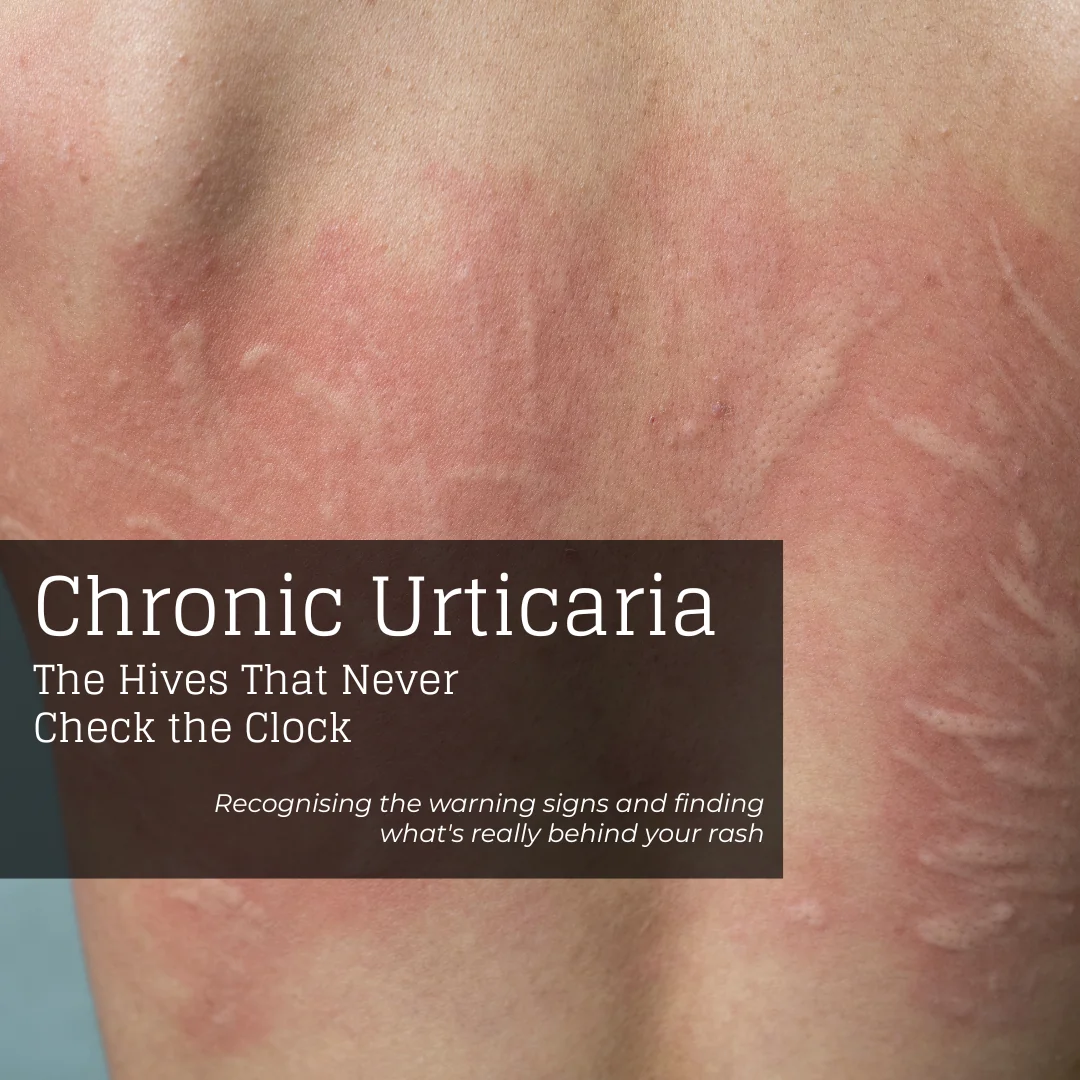
- Red/pink raised welts with clear borders, ranging in size from small dots to larger than a palm.
- Extremely itchy, especially at night, often causing insomnia.
- Each welt disappears within 24 hours but new ones appear elsewhere instead.
- No scabs, no weeping/oozing distinguishing it from contact dermatitis or fungal infections.
Swelling That Shouldn’t Be Ignored
Some patients experience deep skin swelling (Angioedema) in addition to the rash. This often occurs on the lips, eyelids, hands, and feet—and it is especially concerning if the swelling is in the throat area.
How is Chronic Urticaria Different from Acute Urticaria?
Classifying by duration is very important because it dictates different treatment approaches.
- Acute Urticaria: Lasts less than 6 weeks. It usually has a clear cause, such as a drug allergy, food allergy, or viral infection. It is not difficult to treat and resolves when the trigger is avoided.
- Chronic Urticaria: Lasts more than 6 weeks. The rash appears more than 3 times a week continuously for over 6 weeks. Chronic urticaria symptoms require serious medical attention.
Chronic Spontaneous Urticaria (CSU)
- Rashes appear and resolve on their own without clear triggers.
- Autoimmune Linked to autoimmune diseases.
- Often requires continuous treatment.
Chronic Inducible Urticaria (CIndU)
- Dermographism : Scratching the skin leaves a raised mark.
- Cold Urticaria : Triggered by cold exposure.
- Cholinergic : Triggered by sweating or exercise.
What Causes "Chronic Urticaria"?
In most patients, a clear cause cannot be identified (Idiopathic), but there are suspicious factors and mechanisms as follows:
Autoimmune Diseases: Autoantibodies created by the body attack its own cells or organs, directly stimulating a type of white blood cell (Mast cells), causing the body to attack itself.
Chronic Infections: Such as Helicobacter pylori (bacteria in the stomach lining), periodontitis (gum inflammation and infection), Candida (natural yeast on the human body), hepatitis viruses, and parasites.
Thyroid Diseases: Especially chronic autoimmune thyroiditis (Hashimoto’s Disease).
Stress Response: Stimulates mast cells via short chains of amino acids acting as signaling molecules in the nervous system (Neuropeptides).
- Food and Additives: True food allergies account for less than 5% of cases, but certain substances can trigger mast cells, such as NSAIDs (Salicylates), food coloring, preservatives, and alcohol.
Precaution: Let the doctor determine what needs to be tested, and avoid restricting every “risky-looking” food without a valid medical reason.
Warning Signs Requiring Immediate Medical Attention
There are some symptoms you “should not wait” for, nor should you “just take an antihistamine and go back to sleep.” Go to the emergency room immediately if you experience the following:
- Rapid swelling of the throat, tongue, or lips
- Difficulty breathing, panting, or sudden hoarseness
- Low blood pressure, dizziness, or fainting
- Palpitations or an abnormally fast heartbeat
Experiencing multiple symptoms at once could indicate a life-threatening severe allergic reaction (Anaphylaxis). If this happens, you must rush to the Emergency Room (ER) immediately.
Anaphylaxis must be treated with emergency medication (epinephrine), not standard antihistamines. If you have a history of severe allergies, you should carry this medication with you.
Diagnosis and Examination
I always start examinations by “listening,” because a detailed medical history often provides more crucial and useful information than all blood test results combined.
The main diagnostic steps are as follows:
Taking Medical History (The most important step)
Characteristics and Duration: When did the rash start, what time of day does it appear, and how long does it last?
Triggers: Do symptoms flare up with specific exposure, such as food, medication, stress, cold weather, or after exercise?
Medication History: Especially nonsteroidal anti-inflammatory drugs (NSAIDs) or blood pressure medications (ACE inhibitors).
Health History: The patient’s underlying conditions and family medical history.
Basic Blood Tests
General Assessment and Inflammation: Complete Blood Count (CBC) and body inflammation markers (ESR, CRP).
Thyroid Function: Checking for abnormalities via TSH, Free T4, and Anti-TPO.
Detecting Other Hidden Causes: Allergy level test (Total IgE) and checking for stomach bacteria (H. pylori).
Autoimmune Disease Testing: If the doctor has further suspicions, tests for ANA and Anti-dsDNA may be ordered.
Skin Reaction Testing
Skin Prick Test (SPT): Lightly pricking the skin to test for allergens.
ASST (Autologous Serum Skin Test): Testing for autoimmunity; positive results are found in about 40–60% of patients in this group.
Dermographometry: Testing the skin’s hypersensitivity reaction to scratching.
Treatment Guidelines
The key principle of treatment is to start with the simplest and safest methods. If symptoms remain uncontrolled, the intensity of the treatment is gradually increased step by step:
Step 1: 2nd Generation Antihistamines This is the highly safe first-line option. It is usually taken once a day, and if necessary, the doctor can increase the dose up to 4 times. Commonly used medications include:
Cetirizine (10 mg): The most frequently prescribed medication.
Loratadine (10 mg) : Has minimal side effects regarding drowsiness.
Fexofenadine (120/180 mg) : Practically no side effects regarding drowsiness.
Bilastine (20 mg) : A newer generation drug that acts quite fast.
Step 2: Up-dosing If taking step 1 medications doesn’t improve symptoms within 2–4 weeks, the doctor will increase the antihistamine dose by 2–4 times (e.g., increasing Cetirizine from 1 pill to 2–4 pills per day, as appropriate).
Step 3: Add-on Therapy – Montelukast This is a leukotriene antagonist, which may be used in combination to enhance the antihistamine’s effect. It is especially effective for patients whose rashes are triggered by NSAID pain relievers.
Step 4: Biologics – Omalizumab or Xolair If oral medications fail to control symptoms, the doctor may consider prescribing Omalizumab injections, a monoclonal antibody that directly targets allergic antibodies (IgE).
Efficacy : Injected every 4 weeks, it shows significant improvement in 60–70% of patients.
Step 5: Immunosuppressants – Cyclosporin Reserved for severe drug-resistant cases or when caused by autoimmune conditions.
Precaution :
Although effective, it requires close medical supervision, as side effects regarding blood pressure and kidney function must be regularly monitored.
Frequently Asked Questions about Omalizumab (Xolair) Injections
Do I have to inject it for life?
- Not necessarily. The doctor will evaluate the response every 3–6 months to consider reducing the dosage or stopping the medication.)
Is it expensive?
- The medication is quite expensive, but currently, generic alternatives are being produced. In some cases, it may be covered by the universal healthcare scheme.
How safe is it?
- It has a high safety profile, backed by more than 10 years of long-term real-world tracking data.
How many injections before seeing results?
- The response varies from person to person. Some see improvement after the first injection, while others may take about 3 months to see full results.
Frequently Asked Questions (FAQ)
Can Chronic Urticaria be cured?
Do I need to stop eating all types of seafood?
Will taking antihistamines for a long time cause addiction?
Can stress-induced urticaria be treated?
How are hives different from Eczema?

A Message from Dr. Bank
“…Chronic Urticaria is a disease that can stay with a patient for a long time and disrupts daily life more than many might expect. But with today’s medical advancements, we can control this disease much better than before.
What I want to leave you with is, do not try to treat it alone for too long. Because chronic urticaria is different for everyone, the effective treatment varies. Finding the cause and planning the right treatment for you requires a doctor’s evaluation…”
22 Square Clinic : The Home of Skin Expertise.
เพราะความงามของคุณ สมควรได้รับการดูแลจากบ้านที่เข้าใจผิวของคุณที่สุด
Because your beauty deserves a home